

Marriage & Parenthood Measures at National Day Rally 2026
Helping Singaporeans Start and Raise Families with Confidence
Enhanced child-related leave, financial, preschool and housing support to help Singaporeans start and raise families
As announced by Prime Minister Lawrence Wong at the 2026 National Day Rally, the Government will enhance child-related leave, financial help, caregiving and housing measures to give Singaporeans greater confidence and assurance in starting and raising families. These enhancements are the first set of recommendations from the Marriage & Parenthood (M&P) Reset Workgroup to be accepted by the Government. They were shaped by feedback from Singaporeans and respond to practical concerns that parents have shared, including the need for more time for caregiving, help with the cost of raising children, better access to affordable preschool, and housing support as families grow.
2. Together, the enhancements constitute fundamental shifts in how the Government supports M&P. First, while current support is concentrated around the early years of a child, the enhancements will provide stronger, more sustained support for parents throughout the journey of raising their children. Second, while previous enhancements were largely applicable to new births going forward, the latest enhancements strengthen support for existing parents and children. This recognises the importance of making the parenthood journey of all parents more achievable and rewarding, and in so doing, helping others around them see parenthood in the same vein. This is key to shaping more positive mindsets and societal norms toward M&P.
More protected time for parents to balance family and work
3. Childcare Leave (CCL) provisions will be increased to give working parents more protected time to care for their children. The current CCL and Extended Childcare Leave (ECL) will be merged into a new streamlined CCL scheme for working parents with children aged 12 and below.
-
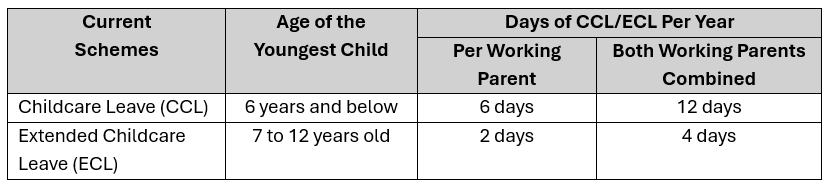
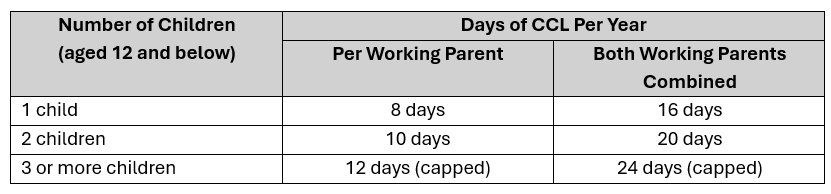
Each working parent will be eligible for 8, 10, or 12 days of CCL per calendar year, based on whether they have one, two, or three or more Singapore Citizen children aged 12 and below. This is an increase from the current provision of 6 days of CCL per year for each working parent when their youngest child is aged 0 to 6, and 2 days of ECL when their youngest child is aged 7 to 12.
4. The Government will also reimburse employers for the full duration of all child-related leave schemes[1], up to the reimbursement cap. This will significantly reduce the cost borne by employers and support them in building work-life friendly workplaces where parents can take leave with greater confidence. Employees are encouraged to discuss leave plans with their employers early where possible, so that caregiving needs and workplace operations can be managed well.
5. More information on the enhancements to child-related leave provisions can be found in Annex A.
Stronger and more sustained financial support through a child’s growing years
6. Parents receive direct financial support for child-raising through the Baby Bonus Scheme and Large Families Scheme. To provide stronger and more sustained support from birth through the growing years, these schemes will be replaced by a new SG Child Support Package.
7. Under the new package, every Singapore Citizen child will receive the same level of support, regardless of birth order. This is a shift away from the current tiering of benefits by birth order under the Baby Bonus Scheme, towards valuing and supporting every child equally.
8. The SG Child Support Package will provide up to $62,000 to every Singapore Citizen child. It comprises:
-
$10,000 Baby Gift in cash, disbursed in two tranches within 12 months of a child’s birth. This provides more substantial upfront help with the higher expenses incurred at birth and in the child’s first year.
-
$32,000 Child Credits in cash, with $2,000 disbursed annually over 16 years, from the year the child turns 1 to the year the child turns 16. This provides sustained help through the child’s growing years.
-
$5,000 Child Development Account (CDA) First Step Grant (FSG).
-
Up to $5,000 in Government co-matching of CDA. The CDA will be extended to the end of year the child turns 16, instead of 12 years old today, giving parents a longer period to benefit from Government co-matching and use CDA funds for approved child-raising expenses.
-
$10,000 top-up to the child’s Post-Secondary Education Account (PSEA) in the year the child turns 17. This will help parents by defraying the costs of higher education.
9. More details on the SG Child Support Package can be found in Annex B. The Package will be extended to all existing Singapore Citizen children born in or turning 1 to 17 in 2026, who will receive benefits based on their corresponding age in 2026 and in subsequent years. Together with the existing benefits – including the $5,000 Medisave Grant for Newborns at birth and annual Edusave contributions across primary and secondary school, which add up to around $2,500 – each Singapore Citizen child receives around $70,000 of direct financial support from birth to age 17.
Additional help for large families
10. As the enhanced baseline support is given for each Singapore Citizen child, large families will naturally receive more support overall, including for their first and second child.
11. Large families with three or more children will also continue to receive additional help on top of the SG Child Support Package in areas where they are likely to face higher costs:
-
The current $5,000 Large Family MediSave Grant (LFMG) helps with healthcare expenses. We are studying how to reposition and extend this support to existing large families that have not received the grant.
-
MOT will provide additional support to help large families manage transport expenses.
-
MND is studying additional housing support for large families.
More affordable and accessible caregiving options through the preschool and primary school years
12. Fees at Government-supported childcare and infant care centres will be significantly reduced to ease preschool costs for families, and access to quality preschool education for parents with young children will be improved.
-
Full-day childcare and infant care fees at Government-supported centres will be reduced to $150 and $300 per month, respectively. The reductions will be implemented progressively, with the target fee levels to be achieved by 2030. Lower-income families will continue to pay even less.
-
Full childcare and infant care subsidies will be extended to families with Singapore Citizen children, regardless of the subsidy applicant’s working status, giving all families better access to affordable preschool. More details will be announced in early 2027.
-
The network of Government-supported preschool operators will be expanded to give families more options for affordable quality preschool places close to where they live. Additional help will be provided to eligible preschool operators that wish to join the network and meet its requirements. More details can be found in Annex C.
13. To better support parents' caregiving needs in the primary school years, the Government will expand capacity, improve the quality of care, and keep fees affordable across student care centres in primary schools. We will also work with selected centres outside schools, to provide more options for parents. MOE and MSF will share more details when ready.
Stronger housing support for growing families
14. From the February 2027 sales exercise, first-timer families with or expecting children will receive one additional ballot chance for each Singapore Citizen child aged 18 and below. This will apply to all BTO and SBF flat applications. More information will be shared in the joint MND-HDB media release on public housing announcements.
Next Steps
15. Minister Indranee Rajah, Minister in the Prime Minister’s Office and Chair of the interagency M&P Reset Workgroup, said: “These enhancements reflect the Government’s response to the first set of recommendations from the M&P Reset Workgroup, and our work continues. While no individual measure can address every concern, these enhancements taken together represent a significant shift in how the Government supports families. They will give parents more time, more financial help, more affordable and accessible care options, stronger housing support, and greater assurance as their children grow.
16. Beyond Government action, effecting a meaningful shift will require working closely with employers, community organisations and other partners to bring about a reset that gives Singaporeans greater hope and assurance to start and raise families, knowing that they will have support at each stage, and to foster a society where marriage and parenthood feel achievable and rewarding. The Workgroup will continue to engage Singaporeans and study further measures to address other concerns that have been raised, including work-life support, fertility and maternity health, relationship formation, and education.”
17. The Workgroup will release a fuller set of recommendations in early 2027.
[1] Child-related leave schemes comprise Government-Paid Maternity
Leave (GPML), Government-Paid Paternity Leave (GPPL), Government-Paid Adoption
Leave (GPAL), Shared Parental Leave (SPL), Childcare Leave (CCL), Extended
Childcare Leave (ECL), and Unpaid Infant Care Leave. The Government currently
does not reimburse the first 8 weeks of the 16-week GPML (for the 1st and
2nd child orders), the first 4 weeks of the 12-week GPAL (for
the 1st and 2nd child orders), and the first 3 days
of the 6-day CCL. The Government already reimburses for the full duration
of GPPL, SPL and ECL.
– End –
For media queries, please contact:
Jeslyn Goh (Ms), Communications and Engagement Directorate,
Strategy Group, Prime Minister’s Office
Contact: 9728 3452 (HP) jeslyn_goh@pmo.gov.sg (Email)
Ng Liyan (Ms), Communications and Engagement Division
Ministry of Social and Family Development
Contact: 9151 1462 (HP) NG_Liyan@msf.gov.sg (Email)
Chan Yee Chun (Ms), Communications and Engagement Division
Ministry of Social and Family Development
Contact: 9739 4215 (HP) Chan_Yee_Chun@msf.gov.sg (Email)
Annex A
Enhancements to Child-Related Leave Provisions
Enhancements to Childcare Leave Entitlements
Today, a working parent whose youngest Singapore Citizen (SC) child
is aged 6 years and below has 6 days of CCL a year. A working parent whose
youngest SC child is aged 7 to 12 has 2 days of Extended Childcare Leave
(ECL) a year.
2. As childcare needs grow with the number of children and continue beyond preschool years, the Government will enhance CCL provisions by:
-
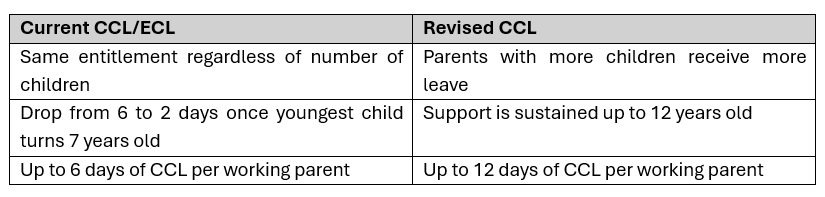
Merging CCL and ECL into a single new CCL scheme for parents with SC children aged 12 and below, by removing tiering by age of youngest child.
-
Increasing the number of CCL days, tiered by number of children: 8, 10, or 12 days a year per working parent for those with one, two, or three or more SC children respectively.
3. Under the new CCL scheme, eligible working parents will receive:
4. In summary,
the revised CCL scheme comprises the following changes:
On Government Covering the Cost of Child-Related Leave
5. Today, employers pay employees the gross rate of pay and are not reimbursed by the Government for the first 8 weeks of the 16-week Government-Paid Maternity Leave (GPML) (1st and 2nd child order), the first 4 weeks of the 12-week Government-Paid Adoption Leave (GPAL) (1st and 2nd child order) and the first 3 days of the 6-day CCL. The Government reimburses employers up to the reimbursement limit of $10,000 for every 4 weeks for the remaining 8 weeks of the 16-week GPML (1st and 2nd child order), the remaining 8 weeks of the 12-week GPAL (1st and 2nd child order) and the remaining 3 days of the 6-day CCL, as well as the full duration of Government-Paid Paternity Leave (GPPL), Shared Parental Leave (SPL) and ECL.
6. To reduce the financial costs borne by employers, the Government will cover the cost for all child-related leave, i.e. GPML, GPAL, GPPL, SPL and CCL for all child orders, up to the reimbursement limit.
7. This will also apply to eligible Self-Employed Persons (SEPs), who can currently claim compensation for income lost during the Government-paid portion of respective child-related leave schemes.
Implementation Details
8. More
details, including the start date of the new CCL scheme, will be announced
at a later date. The Government has been working closely with Tripartite
Partners on these enhancements, and will continue to engage employers and
parents to gather feedback on implementation. Updates to legislation and
systems are also required.
Annex B
SG Child Support Package
The Government will introduce a new SG Child Support Package to provide families with stronger and more sustained financial support in raising their children.
2. The SG Child Support Package, together with the continuation of existing support, will provide every eligible Singapore Citizen (SC) child with around $70,000, from birth to age 17, regardless of birth order. The Package replaces the financial support currently provided through the Baby Bonus Scheme[2] and Large Families Scheme[3].
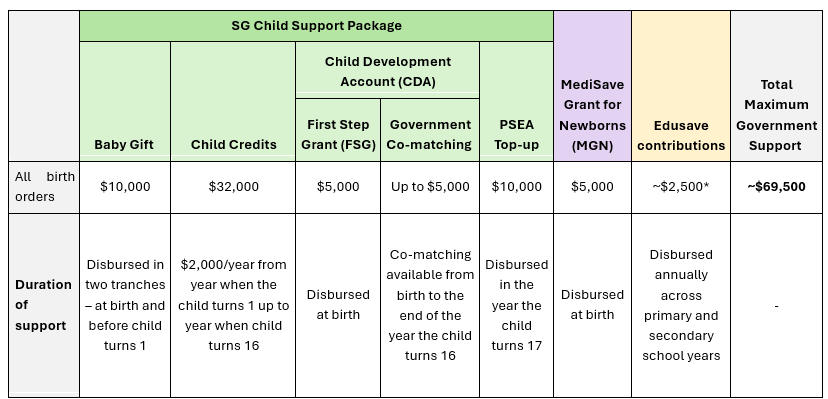
*For students in MOE-funded schools. $230 annually for primary school students, $290 annually for secondary school students. ~$2,500 assumes 6 years of primary school and 4 years of secondary school.
3. The diagram
below illustrates what each eligible SC child will receive under the SG
Child Support Package compared with the current support provided through
the Baby Bonus Scheme and Large Families Scheme, by birth order.
[2] The Baby Bonus Scheme comprises a Baby Bonus Cash Gift (BBCG)
disbursed from age 0 to 6.5, and Child Development Account (CDA) monies
ringfenced for uses such as preschool and healthcare. All children receive
a $5,000 CDA First Step Grant at birth. Parents who save into the CDA receive
Government co-matching up to a cap. Children of higher birth orders (BO)
receive higher BBCG and have higher co-matching caps. BO1 and BO2 children
receive $11,000 in BBCG; and BO3 and higher children $13,000. The CDA co-matching
caps are: BO1 - $4,000; BO2 - $7,000; BO3 and BO4 - $9,000; BO5 and higher
- $15,000.
[3] The Large Families Scheme comprises an additional
$5,000 CDA First Step Grant, $5,000 Large Family MediSave Grant paid into
the mother’s MediSave Account, and $6,000 Large Family LifeSG Credits ($1,000
disbursed annually over 6 years), for each third and subsequent child.
The package provides the same support for every child regardless of birth
order. To do this, the current Baby Bonus Scheme and Large Families Scheme
components which differentiate by birth order will be repositioned or removed.
Notwithstanding this, all birth orders (BOs) will receive more support
under the SG Child Support Package.
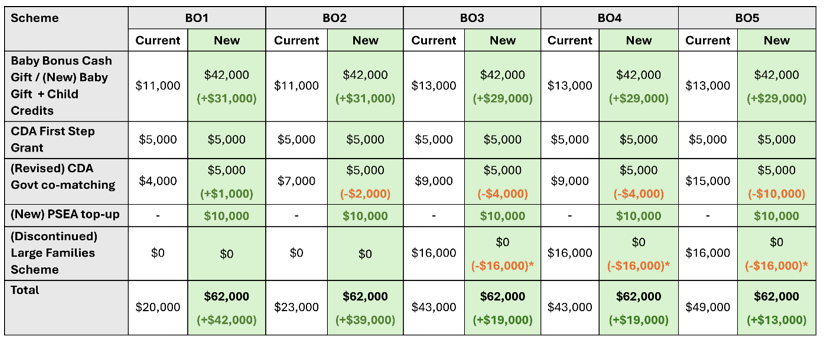
*$16,000 reduction reflects the discontinuation of the Large Families Scheme which currently comprises the additional $5,000 CDA First Step Grant, $5,000 Large Family MediSave Grant (LFMG), and $6,000 Large Family LifeSG Credits (LFLC) ($1,000 disbursed annually over 6 years), for each third and subsequent child. The LFLC will be replaced by the Child Credits and extended to all birth orders. Large families will continue to receive additional support for healthcare expenses and we are reviewing how the LFMG can be repositioned to achieve this.
4.
While the new Package will replace the Large Families Scheme, large families
will continue to be supported.
-
As the enhanced baseline support is given for each child, large families will naturally receive more. For instance, the $1,000 annual LFLC currently given to each 3rd and subsequent child for 6 years will be increased to $2,000, extended to 16 years, and given to all birth orders, including the first and second child in large families.
-
Large families will also receive additional support on top of the Package, in areas where they are likely to face a sharper increase in costs – healthcare, transport and housing. Details will be released at a later date.
Key Changes Under the SG Child Support Package
|
Current Benefits |
SG Child Support Package |
|
|
Varies by birth order |
Each eligible child will receive the same support of up to $62,000[4], regardless of birth order. Large families will continue to receive additional support on top of the Package, in areas where they are likely to face a sharper increase in costs. |
|
|
Focused on early years |
Sustained support is provided from birth to age 17. |
|
|
Approximately equal proportion of support is provided through cash and CDA |
Higher proportion of support provided through cash, giving parents greater flexibility to meet their children’s needs. New uniform co-matching cap of $5,000 makes support more universal across birth orders and income levels, and less dependent on parents’ ability to save into the CDA. |
[4] In addition to the $62,000, every SC child also receives
a $5,000 Medisave Grant for Newborns at birth and annual Edusave top-ups
which add up to around $2,500 across primary and secondary school. Together,
these provide around $70,000 of direct financial support for every SC child.
Implementation and Transition Arrangements
|
$10,000 Baby Gift
|
· Children born on or after 1 Apr 2027 will receive the $10,000 Baby Gift in two tranches before the child turns 1 year old. · Children born before 1 Apr 2027 who are still receiving BBCG payouts will continue to receive BBCG payouts till 31 Mar 2027. As the Baby Gift will replace the BBCG, they will receive a top-up by 30 Apr 2027 to bring their total amount of support to $10,000, if applicable.
|
|
|
$32,000 Child Credits
|
· 2026 Child Credits: Children turning 1 to 16 in 2026 will receive their 2026 Child Credits of $2,000 by 30 Apr 2027. · 2027 Child Credits: Children whose birthdays fall between January and April will receive their 2027 Child Credits of $2,000 by 30 Apr 2027, while those whose birthdays fall between May and December will receive their Child Credits on their birthdays. · 2028 and future Child Credits: Children will receive their Child Credits of $2,000 annually on their birthdays until the year they turn 16. · The Child Credits represent an enhancement of the current Large Family LifeSG Credits (LFLC), with a larger total quantum of $32,000 disbursed over a longer period, and extended to all birth orders instead of only to the third and subsequent child. The LFLC, currently paid in April each year, will therefore cease, with no disbursements in 2027.
|
|
|
CDA and PSEA co-matching[5] |
· Children born on or after 1 Apr 2027 will receive $5,000 CDA First Step Grant (FSG) and be eligible for the CDA Government co-matching contributions up to the uniform cap of $5,000. · The additional CDA FSG of $5,000 under the previous Large Families Scheme will be discontinued from 1 Apr 2027. · For children born between 1 Jan 2015 and 31 Mar 2027 (i.e., turning 1 to 12 in 2027, or born in 2027 before start of uniform cap): o Their existing CDA co-matching caps will be retained until 30 Sep 2027 to give families time to save more in the CDAs to receive the Government co-matching contributions. o Their CDA Government co-matching cap will be adjusted to the uniform cap of $5,000 from 1 Oct 2027. · For children born between 1 Jan 2009 and 31 Dec 2014 (i.e., turning 13 to 18 in 2027), their eligibility for PSEA co-matching, if applicable, remains unchanged (i.e. they may receive co-matching on PSEA until the day before their 18th birthday): o Their existing PSEA co-matching cap will be retained until 30 Sep 2027. o Their PSEA co-matching cap will be adjusted to the uniform $5,000 co-matching cap from 1 Oct 2027. · PSEA co-matching will cease for new PSEAs opened from 1 Jan 2028.
|
|
|
Extension of CDA to age 16
|
· Children born on or after 1 Jan 2015 will have their CDAs extended to the end of the year they turn age 16. · Children born before 1 Jan 2015 will continue to retain their PSEAs, as their CDAs would have closed by then.
|
|
|
$10,000 PSEA top-up
|
· Children turning 17 in 2026 will receive the $10,000 top-up in Jun 2027. · Children turning 17 from 2027 will receive the $10,000 top-up in Jun of the year they turn 17. |
[5]The PSEA allows parents to continue receiving dollar-for-dollar Government co-matching contributions before the child turns 18, if they have not met the CDA co-matching cap before the CDA closes.
Annex C
Enhancements to Childcare and Infant Care
The Government will further enhance the affordability and accessibility of childcare and infant care for Singapore Citizen (SC) children by:
-
Significantly reducing fees for Government-supported preschools;
-
Extending full childcare and infant care subsidies to families with SC children regardless of the working status of the main subsidy applicant; and
-
Expanding the network of Government-supported preschool operators.
Lower Fees for Government-Supported Preschool
2. When fully implemented, full-day SC childcare fees at Government-supported centres will be reduced to $150 per month before means-testing. Full-day infant care fees will be reduced to $300 per month before means-testing.
3. These fees will be less than half of today’s fees. Lower-income families will continue to pay even lower means-tested fees.
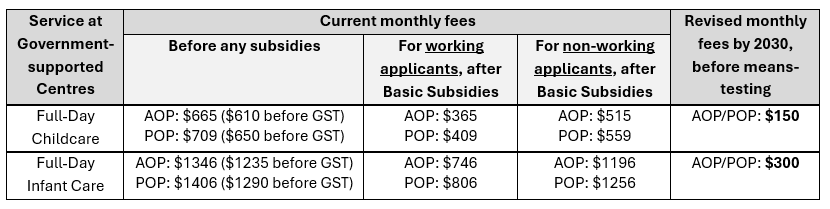
4. These fee reductions will be rolled out progressively from 2028, with target fee levels expected to be reached by 2030. More details on implementation timelines will be shared in early 2027. This phased approach gives the sector the time needed to adjust sustainably, while ensuring that quality of care and education is maintained throughout the transition.
Extending Full Childcare and Infant Care Subsidies to Families with SC Children Regardless of the Applicant’s Working Status
5. Today, full preschool subsidies are only available to families where the main subsidy applicant is working[6]. To ensure that all families can benefit from affordable preschool regardless of their employment circumstances, the Government will eventually extend full childcare and infant care subsidies to families with SC children regardless of the applicant’s working status. More details will be announced in early 2027.
Continued Expansion of Government-Supported Preschool
6. The Government will continue to expand the network of Government-supported preschool operators, to provide families with greater access to affordable, quality preschool services. Additional support will be provided to eligible non-Government-supported operators to come onboard the network.
7. The Government will also ramp up the number of infant care spaces available and expand the infant educator workforce. More details will be shared when ready.
[6]Working main applicant refers to the mother (or single father for divorced, separation or widowed cases) who works at least 56 hours per month. This includes full-time, part-time and freelance work arrangements.